Introduction
When I started my masters in Regulatory Affairs at Northeastern, I had already spent years in pharmacovigilance. Processing ICSRs, coding MedDRA terms, writing aggregate reports. I thought I knew safety reporting. Then I encountered medical device regulatory requirements for the first time, and my first instinct was that this was a completely different world.
It is not. And that realization changed how I think about both domains.
This guide is for anyone with a PV background who has looked at 21 CFR Part 803 or EU MDR 2017/745 and felt lost. I want to show you that the foundation you already have in pharmacovigilance translates further than you think, and where the real differences lie.
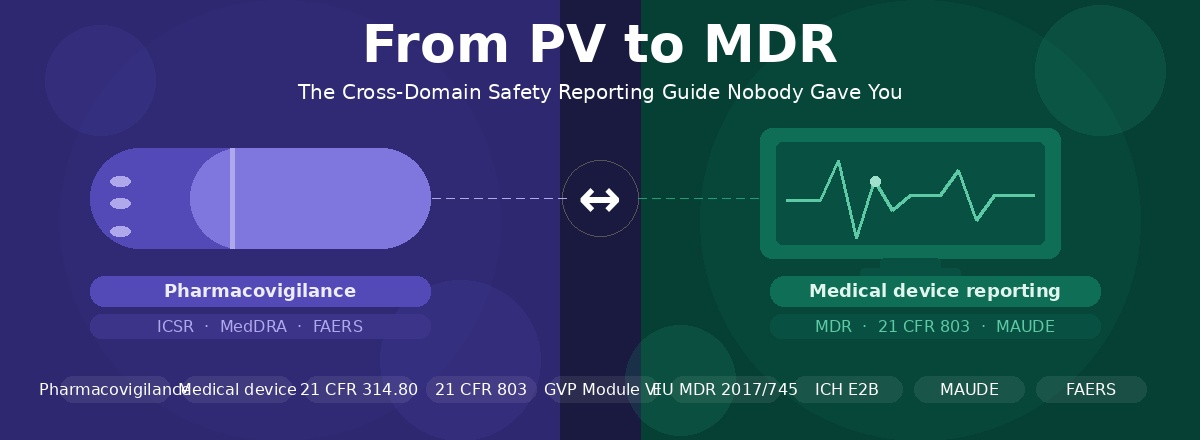
Pharmacovigilance and Medical Device Reporting are often treated as two separate disciplines. One deals with drugs. The other deals with devices. The acronyms are different. The regulators speak differently. Even the forms look different. But the underlying mission is identical. Detect harm. Assess it systematically. Report it accurately. Get it to the right authority on time. Prevent it from happening again.
By the end of this article, you will be able to map your existing PV knowledge directly onto the medical device reporting framework, understand where the two systems genuinely diverge, and know exactly which regulations and concepts to focus on if you are building cross-domain expertise.
What is pharmacovigilance?
"Pharmacovigilance is the science and activities relating to the detection, assessment, understanding and prevention of adverse effects or any other medicine-related problem." — World Health Organization
Key regulations governing PV
Governs IND safety reporting during clinical trials. Covers expedited reporting of SUSARs.
View on eCFR →Governs post-marketing adverse drug experience reporting. Defines 15-day expedited and periodic reporting obligations.
View on eCFR →Covers PADERs. Quarterly reports for first 3 years post-approval, then annual reporting.
View on eCFR →Guideline on good pharmacovigilance practices: Module VI governs collection, management and submission of reports of suspected adverse reactions. Rev 2, in effect 22 November 2017. EMA/873138/2011. Refer to EMA GVP Module VI →
The 4 elements of a valid ICSR
Not every report that lands in your safety database is a valid ICSR. Under ICH E2B and GVP Module VI, a case must contain at minimum four elements. Missing even one means the case cannot be processed or submitted.
At least one piece of information to identify a unique patient. Full name not required.
At least one identifiable person who reported the reaction. HCP, patient, consumer, or lawyer.
At least one medicinal product suspected to have caused or contributed to the adverse reaction.
At least one adverse reaction described. Coded using MedDRA PT under the appropriate SOC.
All four elements must be present for a case to be considered valid under ICH E2B(R3) and GVP Module VI. If any one element is missing, the case is incomplete and must be followed up before processing or submission.
Seriousness and expectedness
An adverse drug reaction is classified as serious if it meets any one of the following six criteria:
- Death
- Life-threatening (risk of death at time of event)
- Hospitalization (initial or prolonged inpatient stay)
- Persistent disability (significant disruption of normal life)
- Congenital anomaly (birth defect in offspring)
- Medically significant (important medical event per investigator judgment)
A case must be BOTH serious AND unexpected (not listed in the RSI) to trigger a 15-day expedited report. A serious but expected event goes into periodic reporting. A non-serious event goes into periodic reporting regardless of expectedness. Expectedness is assessed against the RSI, typically the CCDS or local Product Information (PI).
The Argus ICSR processing workflow
QC fail loop: cases that fail QC return to Data Entry for correction before proceeding.
What is medical device reporting?
Medical Device Reporting (MDR) is the mandatory system by which manufacturers, importers, and device user facilities report device-related deaths, serious injuries, and malfunctions to regulatory authorities. Just like PV in pharma, the goal is to detect safety signals, protect patients, and trigger corrective action where needed.
"The MDR regulation contains mandatory requirements for manufacturers, importers, and device user facilities to report certain device-related adverse events and product problems to the FDA." — U.S. FDA, 21 CFR Part 803
Key regulations governing MDR
Primary US regulation. Covers manufacturers (30-day and 5-work-day reports), importers, and device user facilities (10-day).
View on eCFR →Article 87 governs serious incident reporting timelines. Submission via EUDAMED to national CAs and Notified Body.
View on EUR-Lex →Covers MedWatch 3500A, MAUDE database submission, and mandatory vs voluntary reporting.
View on FDA.gov →Who must report under 21 CFR Part 803?
Unlike PV where the MAH bears primary responsibility, MDR splits obligations across three distinct groups:
- Report death, serious injury, and malfunctions within 30 calendar days
- Urgent events within 5 work days
- Most comprehensive obligations under Part 803
- Report death and serious injury to FDA and manufacturer within 30 days
- Report malfunctions to manufacturer only
- Governed by 21 CFR 803.40
Hospitals and health care centers report deaths to FDA and manufacturer, serious injuries to manufacturer only, within 10 work days. Governed by 21 CFR 803.30.
EU MDR 2017/745 Article 87 reporting timelines
| Event type | Timeline |
|---|---|
| Serious public health threat | Within 2 calendar days |
| Death or unanticipated serious deterioration | Within 10 calendar days |
| Any other reportable serious incident | Within 15 calendar days |
| Field safety corrective action (FSCA) | In advance of action |
| Submission platform | EUDAMED (national CAs until fully operational) |
| Also notify | Notified Body for Class IIa, IIb, III devices |
MDR reportability criteria
Under 21 CFR Part 803, a device event is reportable when:
- The device may have caused or contributed to death (30-day report)
- The device may have caused or contributed to serious injury (30-day report)
- The device malfunctioned AND would likely cause death or serious injury if the malfunction recurred (30-day report)
- Remedial action is required to prevent unreasonable risk to public health (5 work-day report)
Under 21 CFR 803.50(a)(2), a manufacturer must report a malfunction even if no patient was harmed, as long as the malfunction would likely cause or contribute to death or serious injury if it were to recur. This predictive, risk-based reporting has no direct equivalent in pharmaceutical PV.
The reporting threshold is whether information "reasonably suggests" device involvement, not whether the device definitively caused the event. This mirrors the PV principle that all suspected reactions should be reported regardless of confirmed causality.
The MDR event reporting workflow
Review fail loop: cases that fail quality review return to QMS data entry for correction.
- Argus Safety (Oracle)
- Veeva Vault Safety
- ArisGlobal LifeSphere
- Destination: FAERS / EudraVigilance
- Greenlight Guru
- MasterControl
- Veeva Vault QualityDocs
- Destination: MAUDE / EUDAMED
Key differences you need to know
The frameworks are parallel but they are not identical. Here are the five most important differences between pharmacovigilance and medical device reporting.
1. Malfunction reporting is unique to MDR
In PV, you report harm that already happened to a patient. In MDR, you also report device malfunctions that have not yet caused harm but would likely cause death or serious injury if they recurred. This predictive, risk-based reporting requirement has no equivalent in pharmaceutical PV.
- Report adverse reactions only
- No harm, no report
- Report harm AND malfunctions
- Reportable even with no patient harmed yet
2. Who bears reporting responsibility
In PV, the MAH bears primary reporting responsibility. Under 21 CFR Part 803, obligations are split across three distinct groups with separate timelines and submission targets. Device user facilities like hospitals have their own independent reporting obligations that do not exist in pharmaceutical PV.
- MAH is primary responsible party
- Single reporting obligation
- Manufacturer + importer + device user facility
- Three separate obligations and timelines
3. Notified Bodies are a device-specific layer
Under EU MDR 2017/745, Class IIa, IIb, and III devices require independent third-party assessment by a Notified Body before CE marking. There is no equivalent in EU pharmaceutical regulation.
- EMA and national CAs are direct regulators
- No third-party certification required
- Notified Body independently assesses and certifies
- Vigilance reports also go to Notified Body
4. Causality assessment approach
In PV, causality is assessed using standardized scales such as Naranjo and WHO-UMC. In MDR, the question is more engineering-focused: did the device malfunction, and did that malfunction cause or contribute to the event?
- Naranjo / WHO-UMC causality scales
- Clinical judgment on drug-reaction relationship
- Engineering and clinical judgment combined
- Did device malfunction? Did it contribute to harm?
5. Reporting timelines and triggers
PV expedited reporting is triggered by seriousness AND unexpectedness. MDR has no expectedness assessment. If reportable, the 30-day clock starts regardless of whether the event was anticipated in the device labeling.
- Serious AND unexpected = 15-day expedited
- Serious but expected = periodic only
- Reportable event = 30-day report
- No expectedness filter applied
The common ground
Despite their differences, PV and MDR share more than most professionals realize.
MedWatch 3500A is used for both drug and device reporting in the US. Same form, same FDA portal.
PSUR exists in both frameworks. EU MDR requires Periodic Safety Update Reports for devices.
Detect harm. Assess it. Report it. Prevent it. The product changes. The mission does not.
MedDRA coding is increasingly adopted in device safety databases, especially for combination products and SaMD.
Both systems require structured PMS plans. EU MDR Article 83 mirrors the pharma PMS framework.
Both FAERS and MAUDE are used for signal detection by FDA using the same analytical methodology.
Combination products: where both worlds collide
Combination products sit at the exact intersection of PV and MDR. A drug-device combination must comply with both frameworks simultaneously. As combination products grow in the market, professionals with fluency in both systems will be increasingly rare and valuable.
There are two MedWatch forms and they work together
MedWatch 3500A is the mandatory form used by manufacturers, MAHs, importers, and user facilities. But many of those reports are triggered by a MedWatch 3500B, the voluntary form used by healthcare professionals, patients, and consumers. The 3500B is how real-world safety signals first enter the system.
PV to MDR: side by side
If you know pharmacovigilance, you already speak most of the MDR language. Here is your direct translation guide.
| PV Drugs and biologics | MDR Medical devices | |
|---|---|---|
| Core Reporting UnitICSR (Individual Case Safety Repor) | = | Core Reporting UnitMDR (Medical Device Report) |
| US Regulation21 CFR 312.32 / 314.80 / 314.81 | = | US Regulation21 CFR Part 803 |
| EU RegulationGVP Module VI | = | EU RegulationEU MDR 2017/745 Article 87 |
| Global StandardICH E2A / ICH E2B(R3) | = | Global StandardIMDRF guidelines |
| Processing SystemArgus Safety / Veeva Vault Safety / ArisGlobal | ≠ | Processing SystemQMS: Greenlight Guru / MasterControl / Veeva Vault |
| Expedited Timeline15 calendar days (serious + unexpected) | ≈ | Standard Timeline30 calendar days (death, serious injury, malfunction) |
| Urgent Timeline7-day IND report (fatal / life-threatening SUSAR) | ≈ | Urgent Timeline5 work days (unreasonable risk to public health) |
| Expectedness ReferenceRSI CCDS / Product Information (PI) | ≈ | Expectedness ReferenceDevice labeling / Instructions for Use (IFU) |
| Primary Responsible PartyMAH (Marketing Authorization Holder) | = | Primary Responsible PartyManufacturer + importer + user facility |
| US Safety DatabaseFAERS (FDA Adverse Event Reporting System) | ≠ | US Safety DatabaseMAUDE (Manufacturer and User Facility Device Experience) |
| EU Safety DatabaseEudraVigilance | ≠ | EU Safety DatabaseEUDAMED |
| Submission Form (US)MedWatch 3500A | = | Submission Form (US)MedWatch 3500A |
| Coding TerminologyMedDRA PT and SOC | ≈ | Coding TerminologyDevice problem codes / MedDRA (increasingly adopted) |
| Aggregate ReportingPSUR / PBRER / PADER | ≈ | Aggregate ReportingPSUR (EU MDR) / Annual MDR summary reports (US) |
| Post-Market SurveillancePost-Marketing Surveillance / RMP | = | Post-Market SurveillancePost-Market Surveillance plan (EU MDR Article 83) |
Symbol key: = identical ≈ equivalent ≠ different
- Expectedness against RSI: listed vs unlisted drives reporting obligation
- MedDRA coding: PT, SOC, HLT, HLGT hierarchy for signal detection
- Causality scales: Naranjo, WHO-UMC for drug-event relationship
- Case narrative: structured chronological summary in standardized format per ICH E2B
- ICH E2B(R3) XML format for electronic ICSR transmission
- Malfunction reporting: reportable even when no patient was harmed yet
- Three reporter types: manufacturer, importer, device user facility
- Notified Body involvement for Class IIa, IIb, III devices (EU)
- Field Safety Corrective Actions (FSCAs): device recalls reported separately
- MDR event file: retained for device expected life plus 2 years
Two systems. One mission.
When I started my masters in Regulatory Affairs at Northeastern, I had already spent years in pharmacovigilance. Processing ICSRs, coding MedDRA terms, writing aggregate reports. I thought I knew safety reporting. Then I encountered medical device regulatory requirements for the first time, and my first instinct was that this was a completely different world.
It is not. And that realization changed how I think about both domains.
The regulations are different. The timelines are different. The terminology is different. But the underlying logic, detect harm, assess it systematically, report it accurately, prevent it from happening again, is identical. That logic does not change whether you are processing an ICSR in Argus or assessing a device malfunction under 21 CFR Part 803.
If you come from pharmacovigilance, you are not starting from zero when you look at medical device reporting. You are translating. And translation is a skill you already have. The 4 elements of a valid ICSR map directly onto the MDR event file. The seriousness criteria in PV mirror the reportability triggers in MDR. Even the submission form is the same, MedWatch 3500A on both sides.
The field is moving toward convergence. Combination products, AI-enabled devices, drug-device combinations require PV and MDR expertise simultaneously. Professionals who can operate fluently in both domains will be increasingly rare and increasingly valuable.
Patient safety is patient safety. The product changes. The mission does not.
This article is the starting point. The regulations, the flowcharts, the translation dictionary, use them. Go deeper into 21 CFR Part 803. Read EU MDR 2017/745 Article 87. The frameworks are not as intimidating as they first appear, especially when you already speak the language underneath.
References
- 21 CFR Part 312.32 IND Safety Reporting. https://www.ecfr.gov/current/title-21/chapter-I/subchapter-D
- 21 CFR Part 314.80 Postmarketing reporting of adverse drug experiences. https://www.ecfr.gov/current/title-21/chapter-I/subchapter-D
- 21 CFR Part 314.81 Other postmarketing reports. https://www.ecfr.gov/current/title-21/chapter-I/subchapter-D
- 21 CFR Part 803 Medical Device Reporting. https://www.ecfr.gov/current/title-21/chapter-I/subchapter-H
- EMA. Guideline on good pharmacovigilance practices (GVP) Module VI Rev 2. EMA/873138/2011. https://www.ema.europa.eu/en/documents/regulatory-procedural-guideline/guideline-good-pharmacovigilance-practices-gvp-module-vi-collection-management-and-submission-reports_en.pdf
- Regulation (EU) 2017/745 on medical devices. Official Journal of the European Union. https://eur-lex.europa.eu/legal-content/EN/TXT/?uri=CELEX:32017R0745
- FDA. Medical Device Reporting (MDR): How to Report Medical Device Problems. https://www.fda.gov/medical-devices/medical-device-safety/medical-device-reporting-mdr-how-report-medical-device-problems
- FDA. Mandatory Reporting Requirements: Manufacturers, Importers and Device User Facilities. https://www.fda.gov/medical-devices/postmarket-requirements-devices/mandatory-reporting-requirements-manufacturers-importers-and-device-user-facilities
- ICH E2A: Clinical Safety Data Management. https://www.ich.org/page/safety-guidelines
- ICH E2B(R3): Electronic Transmission of Individual Case Safety Reports. https://www.ich.org/page/safety-guidelines
- International Medical Device Regulators Forum (IMDRF). Guidelines. http://www.imdrf.org/
- WHO. The Importance of Pharmacovigilance. Geneva: World Health Organization.
- FDA. FAERS Public Dashboard. https://www.fda.gov/drugs/questions-and-answers-fdas-adverse-event-reporting-system-faers/fda-adverse-event-reporting-system-faers-public-dashboard
- FDA. MAUDE Adverse Event Reporting. https://www.accessdata.fda.gov/scripts/cdrh/cfdocs/cfmaude/search.cfm
- European Commission. EUDAMED European Database on Medical Devices. https://ec.europa.eu/tools/eudamed


Comments