Abstract
The rapid integration of artificial intelligence (AI) into pharmaceutical and medical technology industries presents significant governance challenges. ISO/IEC 42001:2023, the world’s first international standard for Artificial Intelligence Management Systems (AIMS), provides a structured framework for organizations to establish, implement, maintain, and continually improve responsible AI practices. This article examines the implications of ISO 42001 for pharma and medtech organizations, focusing on three critical requirements: patient safety, data integrity, and accountability. Drawing on regulatory frameworks including 21 CFR Parts 312, 314, and 803, EU MDR 2017/745, EU GVP Module VI, ICH E2B, and the EU AI Act (effective 2 August 2026), this article argues that ISO 42001 is not merely a compliance exercise but a foundational governance framework for regulated industries where AI-driven decisions directly affect patient outcomes. Real-world adoption by major technology vendors, including Microsoft, and complementary FDA draft guidance documents published in January 2025, further underscore the growing operational relevance of this standard for regulatory professionals.
Keywords: ISO/IEC 42001, artificial intelligence management system, pharmacovigilance, medical devices, regulatory affairs, FDA, EU AI Act, responsible AI, data governance
1. Introduction
Artificial intelligence is evolving faster than most of us can keep up with. And while it has quietly become part of our everyday lives, regulated industries like pharma are not just adopting it freely. They are doing so carefully, on their own terms.
As someone working in regulatory affairs, I always wondered: what exactly are those terms? Does the FDA have guidance on this? Does the EMA? Is there a standard that tells companies how to use AI responsibly, not just innovatively?
Then I came across ISO/IEC 42001. My first thought, honestly, was that it was some kind of exam or certification I had missed. It is not. And it turned out to be far more interesting than I expected.
2. What Is ISO/IEC 42001?
ISO/IEC 42001:2023 is an international standard published by the International Organization for Standardization (ISO) and the International Electrotechnical Commission (IEC). In simple terms, it is a standardized framework, a common set of rules that any organization using or developing AI can follow.
It specifies requirements for establishing, implementing, maintaining, and continually improving what is called an Artificial Intelligence Management System, or AIMS. Think of AIMS as an organization’s internal structure for making sure AI is being used responsibly, not just efficiently.
The standard applies to any industry that uses or provides AI-based products or services. And in a field like pharma or medtech, where decisions made by or with AI can directly affect patient safety, having that structure is not just helpful. It is becoming essential.
3. Why Pharma and MedTech Specifically?
Pharmaceutical and medical device companies are not casual AI adopters. They operate in environments where a flawed algorithm, an unvalidated model, or an opaque decision can directly affect patient safety. This raises the stakes considerably.
From direct experience in regulatory documentation, AI tools can compress weeks of drafting time into hours. Clinical Study Reports, Non-Interventional Study Reports (NISRs), Informed Consent Documents (ICDs), Plain Language Protocol Synopses (PLPS), Investigator’s Brochures. The time savings are real. But so is the responsibility that comes with it.
Across the industry, AI is being used at nearly every stage: from identifying drug targets in early discovery, to automating signal detection in pharmacovigilance, to powering Software as a Medical Device (SaMD) in clinical settings. The common thread is that in every case, a human still needs to be in the loop, reviewing, validating, and taking accountability for the final output.
This is the core idea: AI is the engine, humans are the drivers. And like any engine, it needs a framework to run safely. That is exactly what ISO 42001 provides.
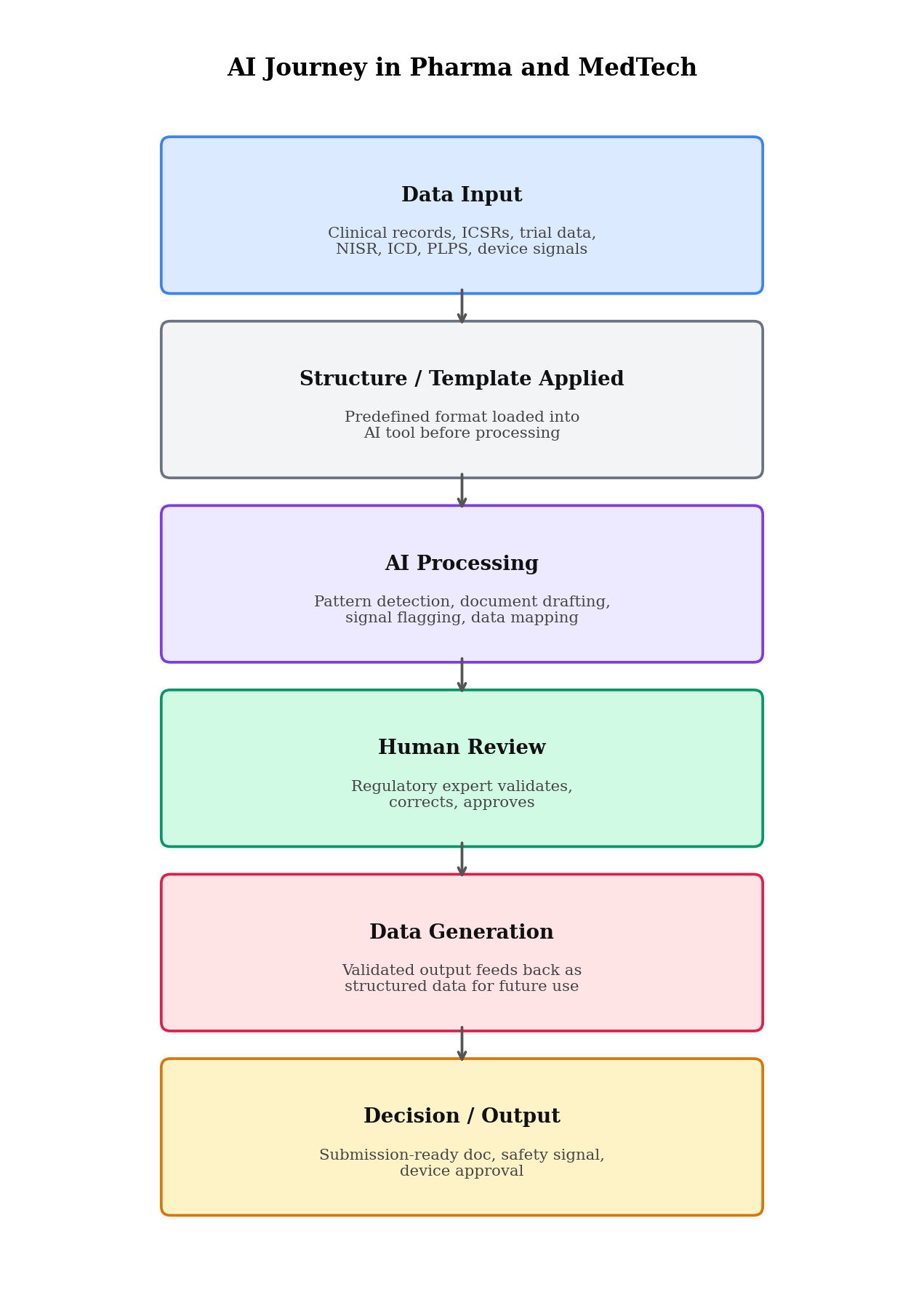 Figure 1. AI journey in pharma and medtech: from data input to decision output.
4. Key Requirements: The Three Things That Matter Most
While ISO 42001 contains 10 clauses and 38 specific controls, three themes stand out as especially critical for pharma and medtech organizations.
4.1 Safety First
AI is not infallible. It can and does make mistakes, especially when given incorrect or incomplete prompts. In pharma and medtech, where decisions directly affect patients, an AI error in a safety report or clinical document is not just a quality issue. It is a patient risk. ISO 42001 requires organizations to build safeguards into every stage of AI use, ensuring that human oversight remains central to any AI-assisted decision.
4.2 Data Is Precious
Patient information, company patents, unpublished trial data. This data is irreplaceable and highly sensitive. Consider the Apple Watch. While the device itself is not classified as a medical device, specific software applications running on it, such as the ECG app and irregular rhythm notification feature, are FDA-cleared Class II medical devices that collect real-time cardiac data from millions of everyday users. Wherever a human being and their health data are involved, privacy and regulatory compliance become non-negotiable.
Using open-access AI tools with confidential data creates a real exposure risk. Once data enters a public AI system, it can become accessible to anyone. Good Data Practice (GDP) and HIPAA exist for exactly this reason.
Innovation is important. But knowing how to protect it is even more so.
4.3 Accountability and Transparency
Regulators do not accept the AI did it as an answer. Someone must always be responsible for what AI produces. A qualified human must validate, approve and stand behind every AI-assisted output. ISO 42001 makes this non-negotiable by requiring clear documentation of who is responsible at every stage of the AI lifecycle.
5. Benefits of Implementing ISO 42001
ISO 42001 is not just a checkbox exercise. For pharma and medtech organizations, implementing it brings four tangible benefits.
5.1 Responsible AI
In retail, a flawed AI recommendation might result in a poor customer experience. In pharma, it can result in a misdiagnosis, an ineffective treatment, or harm to an underrepresented patient population. AI models trained on skewed genomic or electronic health record datasets can worsen existing healthcare disparities rather than solving them. Regulatory bodies increasingly mandate that AI models in life sciences are clear, traceable, and explainable, not opaque black box systems where the logic behind a drug target or treatment pathway cannot be audited. ISO 42001 provides the framework to ensure AI is used ethically and responsibly from the ground up.
5.2 Reputation Management
A pharma or medtech company’s reputation is built on one thing above everything else: patient trust. If an AI tool makes a wrong call, a missed safety signal, an incorrect dosing recommendation, a flawed diagnostic output, the consequences go far beyond a regulatory fine. They erode the trust that patients, healthcare professionals, and regulators place in that organization. ISO 42001 helps organizations demonstrate that their AI systems are governed, validated, and accountable, building confidence rather than eroding it.
5.3 AI Governance
Pharma and medtech companies already operate under some of the strictest regulatory frameworks in the world: 21 CFR Part 312 and 314 (including 314.80 for post-marketing adverse drug experience reporting), 21 CFR Part 803 for medical device reporting, EU MDR 2017/745, EU GVP Module VI, and ICH E2B for electronic ICSR transmission. Now add the EU AI Act, with the majority of its provisions taking effect on 2 August 2026, and the pressure to demonstrate AI governance is only increasing. ISO 42001 provides a structured, internationally recognized framework that aligns with these existing requirements rather than adding to the burden.
5.4 Practical Guidance
Pharma and medtech companies cannot afford to improvise when it comes to AI. The risks are too high, the regulatory scrutiny too intense, and the pace of AI development too fast for any organization to navigate without a framework. ISO 42001 gives organizations 38 specific controls and clear implementation guidance, a practical roadmap for managing AI risks effectively rather than reactively.
6. Real-World Example: Microsoft and ISO 42001
If ISO 42001 still feels abstract, consider what is already happening in the industry. In 2023, Microsoft became one of the first major technology companies to achieve ISO 42001 certification across a range of its AI products, including GitHub Copilot, Microsoft 365 Copilot, Microsoft Copilot Health, Microsoft Copilot Studio, Microsoft Dragon Copilot, Microsoft Dragon Copilot (Radiologist), Microsoft Foundry, and Microsoft Security Copilot.
For pharma and medtech companies, this is significant. Many organizations already use these tools daily, for clinical documentation, regulatory workflows, and data security. Microsoft’s certification provides independent assurance that these AI systems are governed, transparent, and accountable.
However, using a certified vendor does NOT automatically make your organization compliant. Think of it like HIPAA. Just because your software vendor is HIPAA compliant does not mean your organization automatically is. Your organization still needs its own AI management framework in place. Microsoft’s certification gives you a strong, trustworthy foundation to build on, but the responsibility does not stop at the vendor contract.
7. What Is FDA Saying About AI?
While ISO 42001 is an international standard, regulatory agencies are moving fast to keep up with AI, and FDA is no exception. In January 2025, FDA published two landmark draft guidance documents.
The first, “AI-Enabled Device Software Functions: Lifecycle Management and Marketing Submission Recommendations,” provides guidance on the safety and effectiveness of AI-enabled medical devices throughout their entire lifecycle, from design and development through to post-market performance monitoring.
The second, “Considerations for the Use of Artificial Intelligence to Support Regulatory Decision Making for Drug and Biological Products,” was FDA’s first ever guidance specifically on AI in drug development, covering how AI models should be validated and evaluated for regulatory decision-making.
CDER’s 2026 Guidance Agenda has already listed upcoming draft guidance on AI and ML quality considerations in pharmaceutical manufacturing, meaning the regulatory expectations around AI in pharma are only going to increase.
The message from FDA is clear: AI in regulated industries is not a free-for-all. It requires transparency, validation, lifecycle management, and accountability, principles that align directly with what ISO 42001 requires.
ISO 42001 and FDA guidance are not competing frameworks. They are complementary, and together, they are shaping what responsible AI in pharma and medtech looks like.
8. The ISO 42001 Certification Process
Getting ISO 42001 certified is not a one-time event. It is a structured process that mirrors other ISO certifications like ISO 27001 or ISO 13485, which many pharma and medtech companies are already familiar with.
The certification process involves two stages, conducted by an accredited certification body. Stage 1 is a documentation review. The auditor evaluates whether the organization has the right policies, governance structures, risk assessments, and AI impact assessments in place. This typically takes one to two days. Any areas of concern are flagged so the organization can address them before moving forward.
Stage 2 evaluates whether those policies and controls are actually working in practice, not just on paper. Auditors assess operational effectiveness, risk management, and whether the organization’s AI systems are being governed consistently and accountably. This stage can take anywhere from three to nine days depending on the size and complexity of the organization.
Once both stages are successfully completed, an ISO 42001 certificate is issued, valid for three years, with annual surveillance audits to ensure continued compliance.
For organizations already certified under ISO 27001, the journey is more straightforward. Many foundational elements, risk management frameworks, internal audit processes, and continuous improvement mechanisms, can be carried over. ISO 42001 builds on that foundation with additional requirements specific to AI, including ethical considerations, AI impact assessments, and transparency obligations.
Certification is not just a badge. It is operational proof that your AI governance is active, auditable, and accountable at any moment.
9. Conclusion
When I first came across ISO 42001, I genuinely thought it was some kind of exam I had missed. It is not. And the more I learned about it, the more I realized it represents something much more significant: a global acknowledgment that AI, for all its potential, needs a framework to operate responsibly.
For pharma and medtech specifically, the stakes could not be higher. These are industries where decisions affect real patients, where data is irreplaceable, and where regulatory scrutiny is only intensifying. AI has the power to accelerate drug discovery, transform pharmacovigilance, and revolutionize medical device development. But that power comes with responsibility.
ISO 42001 does not slow innovation down. It gives innovation a structure to thrive safely, ensuring that as AI becomes more embedded in our workflows, our governance keeps pace. As regulatory professionals, this is our space. Understanding frameworks like ISO 42001 is not just useful. It is becoming essential.
Innovation is important. But knowing how to protect it is even more so.
References
- ISO/IEC 42001:2023. Information technology, Artificial Intelligence, Management system. International Organization for Standardization. https://www.iso.org/standard/42001
- U.S. Food and Drug Administration. Artificial Intelligence-Enabled Device Software Functions: Lifecycle Management and Marketing Submission Recommendations [Draft Guidance]. Published January 6, 2025. https://www.fda.gov/medical-devices/software-medical-device-samd/artificial-intelligence-software-medical-device
- U.S. Food and Drug Administration. Considerations for the Use of Artificial Intelligence to Support Regulatory Decision Making for Drug and Biological Products [Draft Guidance]. January 2025. https://www.fda.gov/about-fda/center-drug-evaluation-and-research-cder/artificial-intelligence-drug-development
- European Parliament and Council. Regulation (EU) 2017/745 on medical devices (EU MDR). Official Journal of the European Union. 2017.
- European Medicines Agency. Good Pharmacovigilance Practices (GVP) Module VI: Management and reporting of adverse reactions to medicinal products.
- International Council for Harmonisation. ICH E2B(R3): Electronic transmission of individual case safety reports.
- U.S. Food and Drug Administration. 21 CFR Part 314.80: Postmarketing reporting of adverse drug experiences.
- U.S. Food and Drug Administration. 21 CFR Part 803: Medical Device Reporting.
- Liang S. Understanding the role of ISO 42001 in achieving responsible AI. EY Global. April 21, 2026. https://www.ey.com
- Tamura J. What to expect in the ISO 42001 certification process. Schellman. Published June 16, 2025; updated May 31, 2026. https://www.schellman.com/blog/iso-certifications/iso-42001-certification-processs
- Microsoft. Microsoft AI services in scope for ISO 42001 certification. Microsoft Service Trust Portal. https://servicetrust.microsoft.com
- NSF International. ISO/IEC 42001 Artificial Intelligence Management System. https://www.nsf.org/management-systems/information-security/iso-iec-42001-artificial-intelligence-management-system
- MedTech Intelligence. Managing AI in medical technology: From innovation to compliance. April 2026. https://medtechintelligence.com
- U.S. Food and Drug Administration. ECG App: FDA De Novo decision summary (DEN180044). https://www.accessdata.fda.gov/cdrh_docs/reviews/DEN180044.pdf
- National Institutes of Health / PubMed Central. Ethical implications of AI in pharmaceutical care. PMC12076083. 2025. https://pmc.ncbi.nlm.nih.gov/articles/PMC12076083/
- Bipartisan Policy Center. FDA oversight: Understanding the regulation of health AI tools. March 2026. https://bipartisanpolicy.org
- ISMS.online. When ISO 42001 certification is required. https://www.isms.online/iso-42001/certification/when-iso-42001-certification-is-required/
- IntuitionLabs. FDA AI guidance 2026: Drug manufacturing and digital health. 2026. https://intuitionlabs.ai/articles/fda-ai-guidance-2026-drug-manufacturing-digital-health
- Manufacturing Chemist. Why most organisations are failing AI and ISO 42001 audits. 2026. https://manufacturingchemist.com

Comments