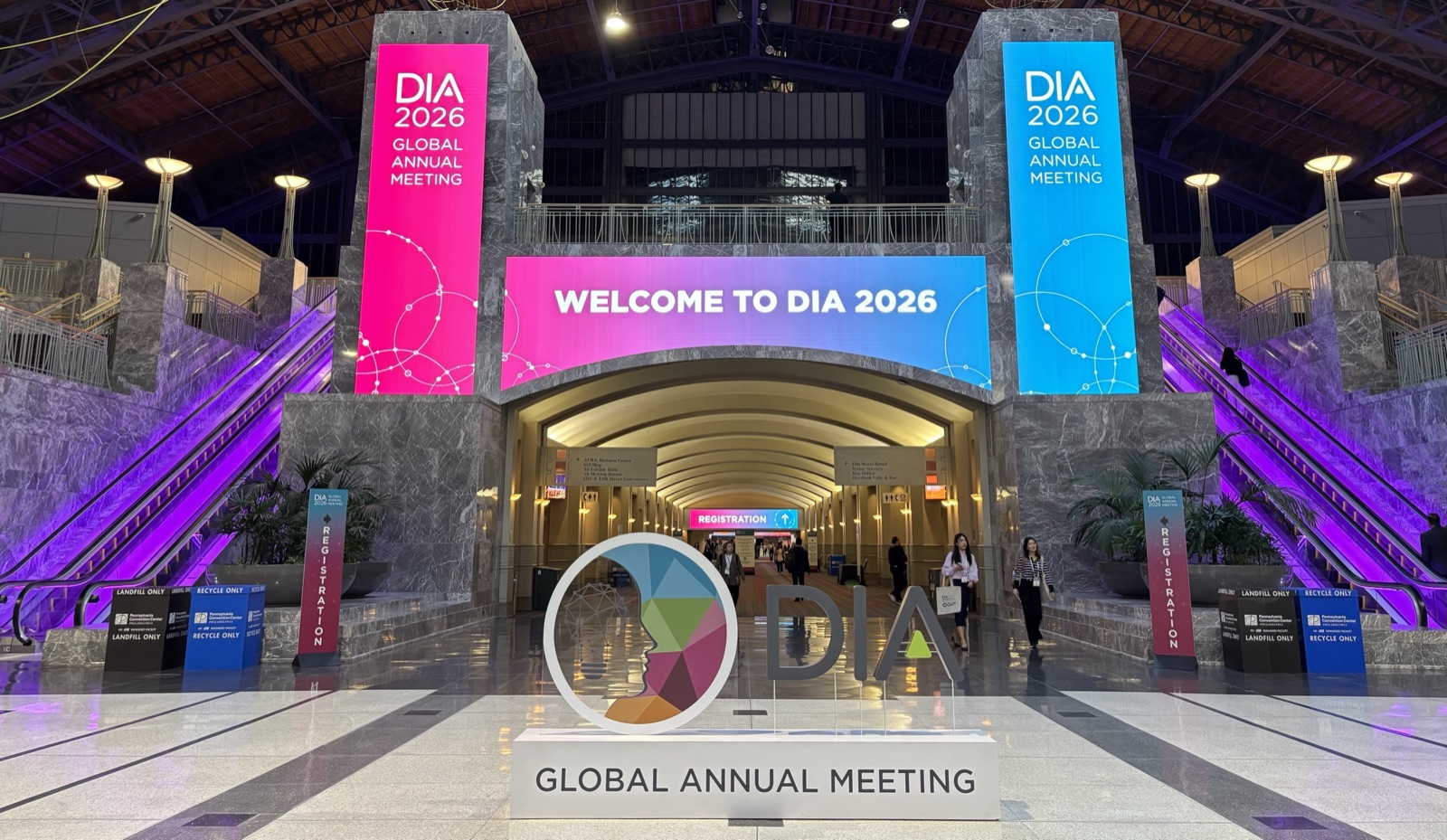
My DIA Global Annual Meeting 2026 Experience
This was my second time volunteering at DIA Global Annual Meeting, and it was a rewarding experience. Between the sessions, the exhibit hall, and the conversations with people I had been looking forward to seeing, this conference packed more into three days than I could have anticipated.
Volunteering at a conference of this scale is genuinely different from attending as a delegate. You are part of the infrastructure. You get to see how the sessions are organized, interact with speakers before and after they present, and meet fellow volunteers who are equally passionate about regulatory science.
This year, I had the chance to reconnect with fellow volunteers and DIA community members including Julia, Jessica, and Sorcha McCrohan. I also got to meet and spend time with Alberto Grignolo, and Chris Slawecki. Both bring decades of experience and a perspective on this industry that you simply cannot get from a textbook.
I also stopped by the Vivpro Corporation booth to reconnect with former colleagues Pravin, Joga, Holly, and Jessica, and attended their session AI in Action: Scaling Regulatory Document Generation Across R&D. Angela Winnier shared her firsthand experience using the REGAIN platform for CSR authoring, a grounded, practical take on what AI-assisted regulatory writing actually looks like day to day.
Beyond that, the exhibit hall and sessions brought a lot of other reconnections, running into people from across the industry, and regulators from FDA and EMA, was a reminder of just how interconnected this field really is.
The Sessions That Stayed With Me
Keynote by David Fajgenbaum (Co-Founder, Every Cure) introducing computational pharmacophenomics, AI trained on biomedical knowledge graphs scoring 74 million drug-disease combinations.
Representatives from four of the world's most influential health agencies speaking openly about how AI is being adopted, evaluated, and governed within their own organizations.
A detailed look at what happened when a major pharmaceutical company committed to using AI across its regulatory submission workflow with published results on IND tox summaries and HAQ/RTQ.
Hidden Potential: Turning Today’s Science into Tomorrow’s Cure
The conference opened with a plenary that set the tone for everything that followed. David Fajgenbaum (Co-Founder and President, Every Cure) delivered the keynote, moderated by Audrey Greenberg (Venture Partner and Chair, Mayo Ventures, Mayo Clinic), with a panel that brought together Rahul Gupta (President, GATC Health), Dave Pfeiffer (Senior Vice President, Head of ARCAS Bio-Tech, Acrisure Re), Greg Sarafin (Chief Administrative Officer, Sovereign AI), and Lawrence Tallon (Chief Executive Officer, MHRA).
The central question was one that anyone in drug development grapples with: how do we turn what we already know into cures that actually reach patients? And increasingly, the answer the panelists kept returning to was AI, applied thoughtfully and at the right points in the pipeline.
David Fajgenbaum used this session to introduce Computational Pharmacophenomics, a field that combines traditional drug repurposing (one disease, many candidate drugs) with indication expansion (one drug, many diseases)), and scales both computationally across all drugs and all diseases simultaneously. The platform trains AI models on biomedical knowledge graphs encoding known drug-disease relationships, protein interactions, phenotypic features, genes, and pathways, generating predicted treatment scores for every possible drug-disease combination across 74 million pairs. The first patient treated using a top-scoring compound has been in remission for over three years, with findings published in The New England Journal of Medicine.
Several broader themes ran through the panel discussion:
AI applied to efficacy and safety evaluation could meaningfully lower the rate of drug failure enabling better go/no-go decisions earlier in the pipeline.
AI is removing the historical shortage of inputs that slowed development. Automation is handling work that previously required significant manual effort, and providers across the ecosystem are becoming super providers organizations that can take on broader scope because AI tools have extended their capabilities.
AI can de-risk the science of drug discovery enough to attract investment, and the conversation centered on making sure that value actually reaches patients.
AI gives you the ability to ask better questions of larger datasets. But good AI-assisted decision-making starts with good scientific and regulatory thinking, not the technology itself.
Lawrence Tallon's presence as CEO of MHRA engaging openly with a conversation about AI's role in de-risking drug development was itself a signal of how much the landscape has shifted.
AI in Regulatory Review and Decision Making: Perspectives from FDA, EMA, MHRA, and PMDA
This was the session I had been most looking forward to. What made it different from most AI-in-regulatory panels was who was sitting at the table: the actual regulatory scientists and policy leads from four of the world’s most influential health agencies, speaking openly about how AI is being adopted, evaluated, and governed within their own organizations.
- AI tools do not make regulatory decisions, they support the human reviewer
- Internal AI review team evaluating digital tools for submission review workflows
- All tools validated using predefined methodologies, free from bias
- No jurisdiction-specific standardized expectations for AI use in submissions yet
- Sponsors must proactively define the role of AI in their processes
- Final review accountability rests unambiguously with human experts
The answer from all agencies was unified. The underlying principles of data integrity do not change based on how the document was generated. Accuracy, completeness, and traceability remain the governing standards. What AI introduces as a distinct new requirement is transparency. Sponsors are expected to clearly disclose where and how AI was used, particularly within risk management frameworks. The tool changes; the responsibility does not.
EMA and MHRA are actively mapping AI use cases in drug development against the EU AI Act risk classification framework. The EU AI Act does not replace GxP principles; it layers additional governance requirements on top of them, around transparency, traceability, and human oversight of AI-assisted outputs.
Cross-Agency Harmonization and the GAIP Principles
FDA and EMA are actively collaborating on joint guidance for AI use in drug development. The two agencies have established a joint framework: the Guiding Principles of Good AI Practice (GAIP) in Drug Development, a 10-point program that spans the entire medicines lifecycle, from early discovery and clinical trials to manufacturing and post-market safety, to ensure AI tools are safe, transparent, and compliant with global GxP standards. Consistency across agencies is being pursued through systematic validation of AI prompts, LLM training alignment, and structured frameworks ensuring AI-generated outputs meet regulatory-grade standards.
In January 2026, FDA’s CDER and CBER jointly published, together with EMA, the Guiding Principles of Good AI Practice (GAIP) in Drug Development, a concrete output of the cross-agency harmonization work the panel was discussing.
Guiding Principles of Good AI Practice (GAIP)
Published jointly by FDA (CDER and CBER) and EMA, the GAIP document outlines 10 principles for industry and product developers using AI in the drug development cycle. The principles are designed to ensure reliability of information, patient safety, and regulatory excellence while allowing the full potential of AI to be realized. Read the full GAIP document →
Threading AI Throughout the Drug Development Lifecycle: An Enterprise Lens
Brandon Rice (CEO and Co-Founder, Weave Bio) and Andrew Robertson (VP, Head of Global Regulatory Policy and Innovation, Takeda) presented one of the most practically grounded sessions of the conference. This was not a theoretical discussion about AI potential. It was a detailed look at what actually happened when a major pharmaceutical company committed to using AI across its regulatory submission workflow.
An AI-native cloud software designed to unify and drive regulatory workflows in drug development, from source to submission. Built around three core principles: outcome-oriented (spanning the full source-to-submission lifecycle), comprehensive real-time collaboration (human and AI working together across authoring, review, studies, and CMC), and AI-native for regulated R&D (source-grounded generation, end-to-end traceability, human accountability, and automatic verification).
Pre-IND Tox Summaries
The challenge in IND authoring is familiar: heavy information lookup across thousands of pages of source study reports, inconsistent structure across pharmacology, PK, and tox reports, and slow initial drafting that creates a bottleneck.
AI handles compilation and first-draft generation; experts add emphasis, conciseness, and completeness. The bottleneck is removed so experts can focus on the judgment work that actually requires them. Published in Human-AI Collaboration Increases Efficiency in Regulatory Writing (Eser et al., arXiv:2509.09738).
HAQ/RTQ: Health Authority Questions and Responses
Parexel x Weave Bio: The Connected Submission
Katie Connelly (SVP Head of Regulatory Affairs, Parexel) and Brandon Rice (CEO, Weave Bio) made a bigger structural argument about how AI transformation in regulatory actually works.
The regulatory submission lifecycle is still highly fragmented. Wwork happens in silos across planning, content creation, review, assembly, and submission. The instinct is to apply AI to fix that. But their argument was sharper: AI does not fix fragmentation. It scales it. If your processes are siloed and manual, applying AI just means you produce siloed, manual outputs faster and at greater volume.
The sequence that actually works:
Throughout all stages, human expertise remains in the lead: scientific and regulatory judgment, interpretation of regulatory context, and critical review.
PMDA: AI in Regulatory Review Reports
PMDA presented a separate session on their internal initiative to deploy document-generation AI for drafting regulatory review reports. This was one of the clearest signals from the conference that AI adoption in the regulatory space is no longer industry-side only. The agencies themselves are actively building and piloting these tools.
How Companies Are Using AI Right Now
| Organization | Use Case | Highlights |
|---|---|---|
| Weave + Takeda | Pre-IND Tox Summaries | 97% faster to first draft; 0 critical regulatory errors; human-in-the-loop authoring across IND, CSR, NDA, and RTQ workflows |
| Weave + Takeda | HAQ/RTQ Management | AI processes 700–1,000+ health authority questions per global filing; 0 errors in question extraction; 68% average AI answer score |
| Vivpro (REGAIN) | Regulatory Document Generation | AI-assisted generation of regulatory submission documents across R&D; practitioners using the platform for day-to-day regulatory writing workflows |
| Yseop | Regulatory Writing Automation | AI-generated submission-ready documents across the CTD pyramid: CSRs, patient narratives, clinical summaries with full traceability; used by Sanofi, Lilly, and others |
| ZYLiQ | Medical and Regulatory Writing | Generative AI platform for CSRs, safety narratives, ICFs, and clinical protocols; compliance with ICH E3 and global standards |
| Every Cure | Drug Repurposing at Scale | AI models trained on biomedical knowledge graphs; scoring 74 million drug-disease combinations; top-ranked compound led to 3+ year remission (published in NEJM) |
| PMDA | Regulatory Review Reports | Document-generation AI piloted internally for drafting review reports; agency-side adoption, not just industry |
| FDA | Submission Review Support | AI tools for data summarization and structured data collection; internal AI review team evaluating digital tools for submission review workflows |
| Collate | End-to-End Regulatory Paperwork | AI platform covering every step of the product lifecycle; creates and streamlines regulatory paperwork across diagnostics, medical devices, and drug development from concept to market |
The Exhibit Hall
The exhibit hall at DIA GAM brings together regulators, CROs, staffing firms, technology vendors, and academic institutions under one roof. I came in with a researched list of priority booths and spent meaningful time at several of them.
Open conversations with agency staff, not a sales pitch, just an exchange about what they are working on. Also visited the Uppsala Monitoring Centre booth, which maintains VigiBase, the WHO's global pharmacovigilance database.
Conversations about the RAC credential, the FRA certification, and where the profession is headed, always grounded and practical.
IQVIA, Parexel, Certara, and PVpharm. Conversations ranged from AI integration into ICSR processing and signal detection workflows, to what regulatory-grade validation of AI tools actually looks like in practice.
Weave Bio, Vivpro, Artos AI, Basil Systems, Yseop, ZYLiQ, Collate, and more showing how AI is being embedded into submission authoring, regulatory intelligence, and eCTD workflows. Collate in particular stood out for its end-to-end approach, using AI to create and streamline regulatory paperwork across diagnostics, medical devices, and drug development, from concept to market. Seeing these tools demonstrated by the people who built them was a useful complement to the session discussions.
What I Am Taking Forward
Every conference gives you information. The good ones give you perspective. DIA 2026 gave me both.
AI in regulatory science is real, it is accelerating, and the agencies are actively engaged with it, not just as something they regulate, but as something they themselves are adopting. The January 2026 FDA-EMA GAIP publication is proof that cross-agency harmonization on AI governance is not just a conversation. It is being formalized.
The consistent message from FDA, EMA, MHRA, and PMDA was clear: data integrity, traceability, human accountability, and transparency are not legacy concepts that AI will supersede. They are the standards that AI must meet.
"Don't let perfect be the enemy of good. Start somewhere. Experiment. Iterate. Much more is learned, much faster, if you have your own hands in the mix."
-- Weave Bio, DIA Global Annual Meeting 2026
That is the energy I am carrying into the rest of 2026.
Grateful to DIA for creating a space where this kind of learning and this kind of community is possible.

Comments